
My First Back Stabbing

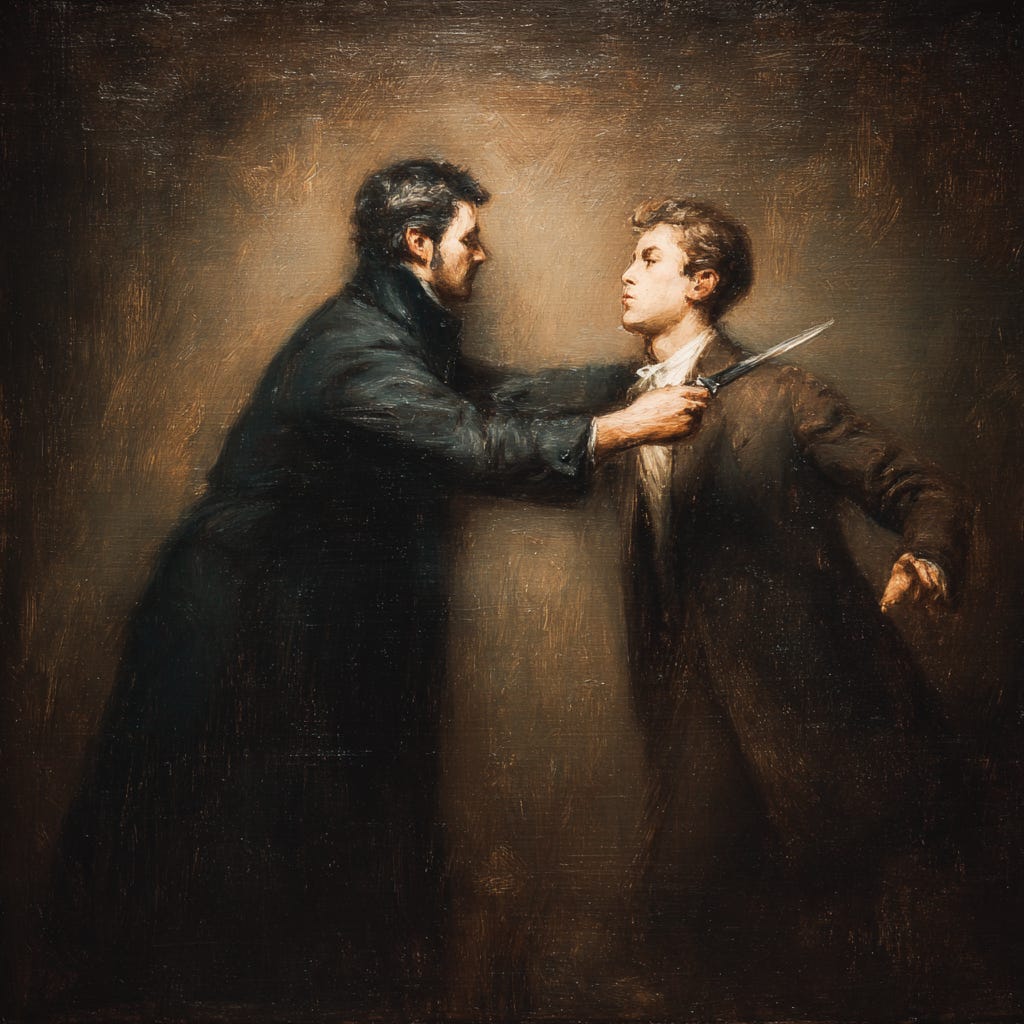
There’s no such thing as reading people better.
That’s the lesson everyone wants you to walk away with after a betrayal: sharpen the read, spot the angle earlier, get better at character assessment. It’s a comforting lesson because it puts you back in control of the variable. If the instrument was the problem, the instrument can be calibrated.
It’s bullshit.
The actual lesson is harder. You read them fine. They moved.
People are not static objects. They change. Money changes them. Proximity to power changes them. So does a conversation at a conference where the right person whispers in their ear at the bar. The person who would not have betrayed you in year one is a different person by year five, and the version of them that emerges in year five is capable of it because life walked them somewhere new while you were focused on the work.
Your read on them was accurate. They were exactly who you thought they were, until they weren’t.
That will mess with your head if you let it, because it removes the comforting fix. You cannot sharpen the instrument and stop this from happening again. You can sharpen it forever and people will still move while you aren’t looking.
I trusted partners with a company my brothers and I built. Some of them walked in and helped build it bigger. Some of them walked in and started measuring the walls. The hard part is that they look identical for the first two years, and sometimes for five.
When the signs come, they’re small. A question about equity that arrives a half-beat too early in a conversation about something else. A board member developing a working relationship with someone on your team that you didn’t initiate and never get a clean explanation for. Meetings rescheduled with thin reasons. The first time someone says “we” in a sentence where you’re supposed to be inside the “we” and you’re not.
None of it is criminal. None of it would survive a deposition. It’s chairs moving around the table while you’re focused on the product, the customer, the thing you thought everyone in the room was there to build. By the time you understand what’s happening, the table isn’t yours.
The money and the company are solvable problems. I’ve watched a business I built end in a bankruptcy auction and I’ve built businesses since, so the math of getting back up isn’t theoretical for me. Accounts and cap tables can be rebuilt. A brand can be rebuilt by anyone with patience and a long enough runway.
The version of you who existed before you found out is the part that doesn’t come back. The one who picked up the phone without checking the name twice. The one who walked into a room with someone and didn’t case the room first. That guy is gone. He doesn’t return no matter how good things get afterward, because he wasn’t a clipboard guy, and once you’ve started keeping the clipboard you can’t unlearn it.
Before the first backstabbing, my natural operating system was immediate trust. I had faith in humanity. People generally do the right thing. The golden rule, treat others how you want to be treated, was the floor I built relationships on, and it still is. That part hasn’t changed.
What changed was my understanding of when the rule stops protecting you.
When you’re small, nobody cares about you. You’re not worth destroying. There’s no reason to strategically and methodically plot out your destruction because there’s nothing on the table worth the work of taking it. The golden rule and a handshake will carry you all the way through the early years, because the stakes are too low to attract anyone with a different operating system.
But at a certain scale, the math of betrayal pencils. Now you have something other people want, in a quantity that justifies the effort of getting it from you. That’s when the game shifts. It isn’t that the people changed first. The stakes changed, and the people followed the stakes.
You don’t see this coming when you’re forty stores in and grinding. You think what got you here is what gets you there. It isn’t. It’s only what got you here. The next part is a different game with the same uniform.
The business world will tell you trust is a strategy. Rational. A function of incentives, contracts, cap tables, and aligned interests. They’ll tell you that if the math is structured tightly enough, trust isn’t even necessary, which is convenient because then nobody in the room ever has to feel anything.
That’s the biggest lie in entrepreneurship.
Trust isn’t a strategy. It’s signing without reading the back page because the guy across the table is your guy. And when it goes wrong, it doesn’t feel like a failed investment. It feels like getting hit by someone you weren’t watching, because why the hell would you be watching them. You trusted them. That was the whole point. You weren’t watching.
There’s a line in the Garden of Gethsemane I can’t get away from. Jesus tells the disciples to watch and pray. They fall asleep. He gets betrayed inside the hour by one of his own. The part that stays with me isn’t the betrayal. Everyone knows about the betrayal. What stays with me is the instruction. Watch and pray. Watch is doing real work in that sentence. Watching doesn’t mean suspicion. It means presence. It means you don’t fall asleep on the people you love.
I had been sleeping on people I loved. Trusting them the way you trust the sun coming up, which is to say with no attention paid. The cost wasn’t just the betrayal when it came. The cost was the years afterward, when I overcorrected so hard I went the other way.
I became the guy who trusted nobody, which I told myself was wisdom. Wisdom sounds a lot like fear when you say it in a certain tone of voice. I built walls. The walls worked. Nothing fell apart. The business kept moving and nobody noticed I was running a fortress instead of a company. The cost showed up at four in the morning, when there’s nobody to blame and nothing to fix and the rage is sitting in the chair across from you waiting for you to notice it never left.
I wore the armor years longer than I needed to. It kept me upright when upright was all I could manage. The crisis passed, the armor stayed on, and I was walking around a peaceful country dressed for a war that had ended, wondering why everything still felt heavy.
I still trust people. After all of it. The alternative is building alone, and building alone has a ceiling that stops well short of anything worth building. Your company, your family, your life. None of it scales solo. The risk doesn’t go away. The only question is whether you take it with your eyes open or your eyes closed.
I take it with my eyes open now. I trust, and I watch. Not the way an auditor watches. The way a man watches a fire he loves and respects. I pay attention to the small moves. Who asks about equity before they ask about the mission. The teammate who builds a relationship with my board that I didn’t initiate. The shift from “we” to “you” the first time something gets hard. Whether someone returns the call after a bad meeting or only after a good one.
Underneath all of it, I own the floor. I know the numbers. I read every contract, every word, including the parts the lawyer says nobody reads, which is also where the worst language tends to live, because nobody reads it. I keep the foundation in my own name. Because someone will eventually choose themselves at my expense. That’s the cost of building with people. And when they do, I want to be standing on something I built and understand. It won’t feel good. But I can stand.
Trust people with your eyes open, watch what shifts when the stakes change, and keep the foundation in your own name. That’s as close to wisdom as I’ve gotten on this one.
— Greg